

 Series 5: God – From A To Z • Workshop 23 (W) of 29
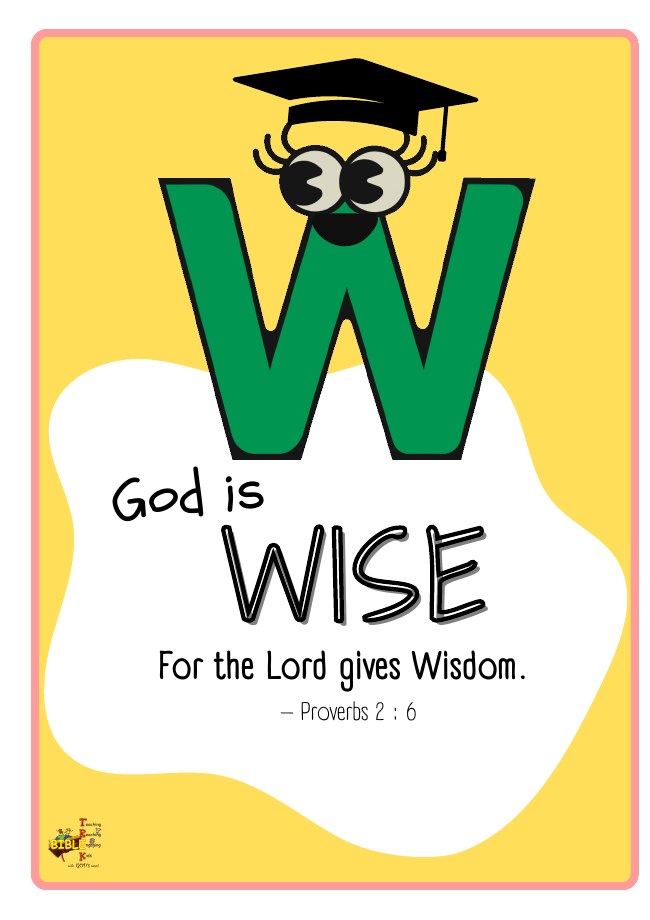
W — God is WISE
 Scripture: Genesis 13 • Proverbs 2:6 • James 1:5
 Duration: 45–60 Min
 Intermediate and Senior

Trailhead Compass: Lesson Goal & Memory Verses
- Teach that God is WISE — all-knowing and generous in guiding our choices.
- Contrast Lot’s selfish choice with Abraham trusting God’s wise plan.
 Memory Verses
1. Worship Time
Begin with worship, actions, and singing aloud to Jesus. Help children follow actions, pick a beat, clap their hands, or just follow along.
2. Introduction: Clear or Sparkly – Choose Wisely!
Materials Needed:
- Two clear cups (labeled A and B)
- Cup A: Clear, clean water
- Cup B: Water mixed with color, glitter, and sprinkles
Instructions:
1. Introduction: “Hi, kids! I have two cups of water here. Look closely.” (Hold up
both cups for the kids to see.) “In Cup A, we have clean, clear water. It’s plain to see. But look at Cup B! Wow! It’s colorful, sparkly, and shiny. Doesn’t it look fun and exciting?”
2. Ask the Children to Choose: “If you were really, really thirsty, which cup would
you choose? Raise your hand if you would pick Cup A—the clean water. Now raise your hand if you would pick Cup B—the sparkly water.” (Pause and let the kids respond.)
3. Ask Why It’s Not Safe: “Now, let’s think about this: Is it wise to drink from Cup
B? Why or why not?” (Let the kids answer: ‘It has glitter,’ ‘It’s dirty,’ or ‘It could make us sick.’)”You’re right! Even though Cup B looks beautiful and fun on the outside, it’s not good for us. It would be foolish to drink it because it could make us sick. The clean water in Cup A is the wise choice!”
4. Connect to Wisdom: “This is just like the choices we make in life. Sometimes,
something might look fun or exciting, like the sparkly water, but it’s not good for us. That’s where wisdom comes in. Wisdom means knowing how to make
good choices. It’s not just knowing things with your brain, but also using what you’ve learned and what God teaches us to make the right choices. God is the
wisest of all! He knows everything, and He loves to help us make good choices when we ask Him. He is like a guide who shows us the best way to go.” Transition to the Lesson: “This reminds me of a story in the Bible about Abram and his nephew Lot. They had to make a big choice too. Lot picked what looked nice, like the sparkly water, but it turned out to be a bad choice. Abram trusted God and acted with God’s wisdom. Let’s hear what happened!”
3. Story Time – Abram and Lot’s Big Decision
Genesis 13
A long time ago, there was a man named Abram. Abram loved God and trusted Him with all his heart. Abram’s nephew, Lot, lived with him, and God had blessed both of them with lots of sheep, cows, camels, and helpers. But there was a problem: there wasn’t enough grass and water for all their animals! Abram’s helpers started arguing with Lot’s helpers. Abram didn’t like the arguing because he wanted peace. He acted with God’s wisdom, which is always pure, gentle and full of good fruits. So Abram went to Lot and said kindly, “Let’s not argue. We are family! There is plenty of land. You pick where you want to live, and I will go the other way.” Lot looked around and saw the green valley near the Jordan River. It had lots of grass and water, and it looked like the very best land! Lot didn’t think about asking God what to do. He only thought about what looked good to him. Lot said, “I will take the green valley.” Then he moved his animals, tents, and family there. But the green valley was very close to a city called Sodom. The people in Sodom did bad things and didn’t listen to God. Lot thought he had chosen the best land, but living near Sodom brought trouble. Abram stayed in the rocky hills. It didn’t look as nice as the valley, but Abram wasn’t worried. He trusted God to take care of him. After Lot left, God spoke to Abram and said, “Look around you, Abram. All the land you see, I am giving to you and your family forever! I will bless you with so many children and grandchildren that they will be as countless as the stars in the sky!” Abram was so thankful. He built an altar to worship God. The Consequences of Their Choices: Lot chose what looked good without
asking God. At first, everything seemed fine. But later, the people in Sodom became so wicked that God decided to destroy the city. Lot and his family had to run away, and they lost everything they had. Lot’s choice brought trouble because he didn’t think about what was wise and good. Abram acted with peace, gentleness, and trust in God. Even though the land he chose didn’t look as good, God blessed Abram. Abram’s choice brought blessings because he trusted God’s wisdom. Sometimes we make choices based on what looks good or what we think is best, just like Lot. But when we trust God and act with kindness and peace, like Abram, God blesses us. The Bible says God’s wisdom is pure, peaceable, and full
of good fruits. That means when we trust God and make choices that follow His
wisdom, good things will happen—even if it doesn’t seem like the best choice at first. Main Takeaway:
God is WISE –He knows everything, and He loves to help us make good choices when we ask Him. He is like a guide who shows us the best way to go.

4. Memory Verse Time
“For the Lord gives Wisdom.” – Proverbs 2:6
Simple hand motions to aid memorization:
“For the Lord”: Point both hands upward toward the sky. “gives”: Hold your hands out in front of you as if you’re giving a gift. “Wisdom”: Point to your head with both hands to symbolize thinking or understanding.
5. Object Lesson: Make a Wish!
Materials Needed:
- A Bible wrapped in shiny gold or silver paper.
Instructions:

1. Start with a Question: “How many of you love getting gifts?” (Wait for excited
responses and raise your hand to encourage participation.)
2. Show the Gift: (Hold up the gold/silver-wrapped Bible.) “Look at this beautiful
gift! It’s shiny, valuable-looking, and very special. Doesn’t it look like something amazing is inside?” (Let them react.) “Now, let’s have a little fun! I want you to close your eyes and make a wish. Imagine this gift is for you, and it has exactly what you want for your birthday. What would you wish for?” Give them time to think and let the kids share what they wished for (taking turns).
3. Talk about Solomon: “Wow! Those are some really great wishes. You all shared
things that are fun, exciting, and valuable. But let me tell you about someone in the Bible who got to ask God for anything he wanted. His name was Solomon. One day, God asked Solomon, ‘What do you want? I will give it to you!’ Now, Solomon could have asked for gold, riches, toys, or even to be famous. But do you know what he asked for? He asked for wisdom.”
4. Teach About Wisdom: “Do you know why Solomon asked for wisdom? Because
he knew something very important. Later, Solomon wrote these words in the Bible: ‘How much better to get wisdom than gold, to get insight rather than silver!’ (Proverbs 16:16) Wisdom is more valuable than anything shiny or
expensive—like gold, silver, or even the coolest toys—because wisdom helps us make good choices. It helps us know right from wrong, and it helps us live in a way that makes God happy.”
5. Unwrap the Gift: “Now, let’s see what’s inside this shiny gift.” (Unwrap the
Bible.) “It’s a Bible! The Bible is God’s Word, and it’s full of wisdom. When we
read the Bible and ask God to help us understand it, He gives us wisdom. That wisdom is even better than gold, silver, or any treasure.”
6. Conclude: “Wisdom is a gift from God. When we ask Him, He gives it generously.
The Bible is full of God’s wisdom to guide us. With His wisdom, we can make good choices, be kind, and follow His perfect plan for our lives.”
7. Wrap Up with Questions:
- Why did Solomon ask for wisdom instead of gold or toys? (Answer: Because wisdom is more valuable and helps us make good choices.)
- What does the Bible say is better than gold and silver?” (Answer: Wisdom.)
- Who can we ask for wisdom?” (Answer: God!)
6. Craftivity: Activity Sheet
Materials Needed:
- A copy of “S5L23-Activity Sheet-Beginners.PDF” for each child
- Colors
Instructions: Distribute one activity sheet to each child and assist them in completing it.
7. Prayer Time
Summary & Main Takeaway
Main Takeaway:
God is WISE –
- 1. God knows everything and is the source of true wisdom.
- 2. His wisdom is better than any treasure because it helps us do what’s right.
- 3. Wisdom is a gift from God—He gives it when we ask.
- 4. The Bible is full of God’s wisdom to help us make good choices, and follow Him.
S5L23 – Activity Sheet – Beginners.pdf
Activity Sheet – Beginner God from A – Z Lesson 23 – God is WISE . -Proverbs 2:6 –
1. Worship Time
Begin with worship, actions, and singing aloud to Jesus. Help children follow actions, pick a beat, clap their hands, or just follow along.
2. Introduction: The Wise Choice Challenge
Materials Needed:
- Two clear cups (labeled A and B)
- Cup A: Clear, clean water
- Cup B: Water mixed with salt (make sure the salt is completely dissolved)
Instructions:
1. Introduction: “Hey, kids! Life is full of choices, right? Every day, we have to
make decisions. If I ask you, ‘Would you rather eat fruits or junk food?’ What would you say? (Pause for answers) That’s an easy, wise choice, right? Choosing fruits is a good decision because it’s healthy. Or, how about this— would you rather go to church or skip it? (Pause for answers) Coming to church is another wise choice because it helps us grow closer to God. Or, let’s say you’re at home—would you rather stay up late playing games or get a good night’s sleep? (Pause for answers) Sleeping well is a wise choice because it helps you stay healthy and focused the next day.”
2. Show the Cups: “But sometimes, we face choices that are harder to make, and
we don’t know which one is best. Now, I have two cups here—Cup A and Cup B. They look exactly the same. They both look clean, but I’m not sure which one is the right choice. One of them is good, but the other is bad. But I need your help to decide which one is better to drink. (Wait for responses.)
3. Do the Taste Test: “So, how do we figure out which one is the wise choice?
Let’s find out together! I need two volunteers to help me. Can you taste a small sip from each cup and help us figure out which one is the better choice? (Let the volunteers taste each cup and give their feedback.)”
4. Ask Questions: “How did it taste? Was one better than the other? What was
different between the two? (Pause for answers.)”
5. Discuss Consequences: “That’s right! One of the cups wasn’t good because it
had salt in it, even though it looked the same as the other cup. In life, sometimes we face tough choices like this. On the outside, things might look the same, but one choice is wise, and the other isn’t. And, sometimes, it’s hard
to know which one is the right one to pick. This is where we need special wisdom. God knows everything and He is the wisest of all! He can help us make the right choice, even when we’re not sure what to do. So, when we don’t know what to do, we can ask God for wisdom, because He sees the big picture and knows what’s best for us.” Transition to the Lesson: “This reminds me of a story in the Bible about Abram and his nephew Lot. They had to make a big choice too. Let’s hear what happened!”
3. Story Time – Abraham and Lot’s Big Decision
Genesis 13
A long time ago, there was a man named Abram. Abram loved God and trusted Him with all his heart. Abram’s nephew, Lot, lived with him, and God had blessed both of them with lots of sheep, cows, camels, and helpers. But there was a problem: there wasn’t enough grass and water for all their animals! Abram’s helpers started arguing with Lot’s helpers. Abram didn’t like the arguing because he wanted peace. He acted with God’s wisdom, which is always pure, gentle and full of good fruits. So Abram went to Lot and said kindly, “Let’s not argue. We are family! There is plenty of land. You pick where you want to live, and I will go the other way.” Lot looked around and saw the green valley near the Jordan River. It had lots of grass and water, and it looked like the very best land! Lot didn’t think about asking God what to do. He only thought about what looked good to him. Lot said, “I will take the green valley.” Then he moved his animals, tents, and family there. But the green valley was very close to a city called Sodom. The people in Sodom did bad things and didn’t listen to God. Lot thought he had chosen the best land, but living near Sodom brought trouble. Abram stayed in the rocky hills. It didn’t look as nice as the valley, but Abram wasn’t worried. He trusted God to take care of him. After Lot left, God spoke to Abram and said, “Look around you, Abram. All the land you see, I am giving to you and your family forever! I will bless you with so many children and grandchildren that they will be as countless as the stars in the sky!” Abram was so thankful. He built an altar to worship God. The Consequences of Their Choices: Lot chose what looked good without
asking God. At first, everything seemed fine. But later, the people in Sodom
became so wicked that God decided to destroy the city. Lot and his family had to run away, and they lost everything they had. Lot’s choice brought trouble because he didn’t think about what was wise and good. Abram acted with peace, gentleness, and trust in God. Even though the land he chose didn’t look as good, God blessed Abram. Abram’s choice brought blessings because he trusted God’s wisdom. Sometimes we make choices based on what looks good or what we think is best, just like Lot. But when we trust God and act with kindness and peace, like Abram, God blesses us. The Bible says God’s wisdom is pure, peaceable, and full
of good fruits. That means when we trust God and make choices that follow His wisdom, good things will happen—even if it doesn’t seem like the best choice at first. Main Takeaway:
God is WISE –He knows everything, and He loves to help us make good choices when we ask Him. He is like a guide who shows us the best way to go.
4. Memory Verse Time
If any of you lacks wisdom, you should ask God, who gives generously to all without finding fault, and it will be given to you. – James 1:5
5. Game: Wise Moves
Materials Needed:
- A simple drawing for each team (like a house, smiley face, etc.).
- Blank paper for each team.
- A marker for each team.
Instructions:
1. Pick two volunteers from each team—one as the “Sketcher” (A) and the other
as the “Guider” (B). Give B the drawing and have them stand behind A. B will trace the drawing on A’s back with their finger, trying to guide A to understand what is being traced. A needs to carefully follow the guidance of B to make the right moves on the paper and complete the drawing accurately. Set a timer for 1-2 minutes. After time is up, compare each team’s final drawing to the original. The team whose drawing is closest to the original wins.
2. Ask Questions: “Was it easy or hard to draw without knowing the full picture?”
“What made it easier – listening to your teammate’s guidance or guessing on your own.?”
3. Relate It to God’s Wisdom: “Let’s think about what just happened. The
‘Sketcher’ didn’t know what to draw because they couldn’t see the original
picture. That’s like us in life—we don’t always know what to do or what’s coming next. The ‘Guider’ knew what the picture was and helped the Sketcher figure it out. This is like God, who knows everything! God sees the big picture and wants to help us make wise choices. But just like you had to pay attention to your guider’s guidance, we need to listen carefully to God.
4. How do we receive God’s Wisdom?
- Seek: We know that God is the source of all wisdom, so we ask Him for wisdom in prayer and rely on Him instead of our own understanding.
- Listen: We listen to God through the Bible and the Holy Spirit, paying close attention to His guidance.
- Obey: When we know the right thing to do, we act on it because wisdom is not just about knowing—it’s about doing!
5. Give Examples: Study vs. Play: “It’s exam week. Do you study or hang out with
friends? God’s Word teaches us to focus on what’s important and be diligent in our responsibilities.” Peer Pressure: “At a party, someone asks you to do something wrong. Do you give in or stand strong? God’s wisdom helps us make choices that honor Him, even when it’s tough.”
6. Conclude: “Life is full of choices, and we don’t always know what’s best. But
God does! When we seek, listen, and obey Him, He will guide us to make wise choices that lead to good results—just like the Guider helped the Sketcher.”
6. Craftivity:
Intermediate: Receiving Hands Card Materials Needed:
…I SE E
wil l
KH im
LIS His TEN Wo to rd OB Dir EY Hi ect s ion s
- Paper (one sheet per child)
- Markers or crayons
- Scissors
Instructions: Give each child a piece of paper and ask them to fold it in half, like a card. Have the kids place their palm on the paper (with the folded edge at the bottom) and trace around their palm. Make sure the side of the palm is near the folded edge of the paper. Once the kids have traced their palms, guide them to cut along the outline of their palms (but leave the part attached at the fold). This will form a “receiving hands” card. On the outside of the card (when folded), have them write: “To Receive God’s Wisdom.” When the card is opened, ask them to write: “I will Seek Him, Listen to His Word, Obey His Directions.” Allow the kids to decorate their card with drawings or words that remind them of seeking God’s wisdom. Explain that the hands are a symbol of how we need to “receive” God’s ive ce Re d’s To Go om… isd W
wisdom. Just as we use our hands to receive things, we need to seek God’s wisdom, listen to what He tells us, and obey His guidance. The hands are ready to receive, just like our hearts should be open to His wisdom. Senior: Wisdom Checklist Materials Needed:
- A strip of paper for each child
- Pens or Markers
Instructions:
1. Begin by Explaining: “We just saw how to receive God’s wisdom—by seeking,
listening, and obeying. God also gives us characteristics of wisdom in His Word to help guide us when we need to make decisions. James 3:14-18 teaches us the difference between worldly wisdom and godly wisdom. Let’s take a closer look at what wisdom really looks like and how we can apply it to our lives.”
2. Create the Checklist: Take a piece of paper and divide it into two columns.
Label one column “Wisdom Is” and the other “Wisdom Is Not.” In the “Wisdom Is” column, write: Pure, Peace-loving, Considerate, Humble, Sincere, Full of mercy and good fruit. In the “Wisdom Is Not” column, write: Selfish, Jealous, Boastful, Dishonest, Harsh.
3. Wrap-up: God’s wisdom helps us make the right choices that honor Him. By
using this checklist, we can better recognize godly wisdom and make wise choices in our everyday lives!
7. Prayer Time
Summary & Main Takeaway
Main Takeaway:
God is WISE –
- 1. God knows everything and is the source of true wisdom.
- 2. When we seek God’s wisdom, listen to what He tells us, and obey His guidance, He will help us make wise choices that honour Him.
- 3. God’s Wisdom is Pure, Peace-loving, Considerate, Humble, Sincere, Full of mercy and good fruit.
Slide-by-Slide Walkthrough (10 Slides)
Cover, Story Slide & Printable Previews (3 Images)

[…] Writing ← All Sunday School Games 🧭 Related Workshop: W — God is WISE → Low-Prep Relay Game • Trusting God’s […]