

 Series 5: God – From A To Z • Workshop 03 (C) of 29
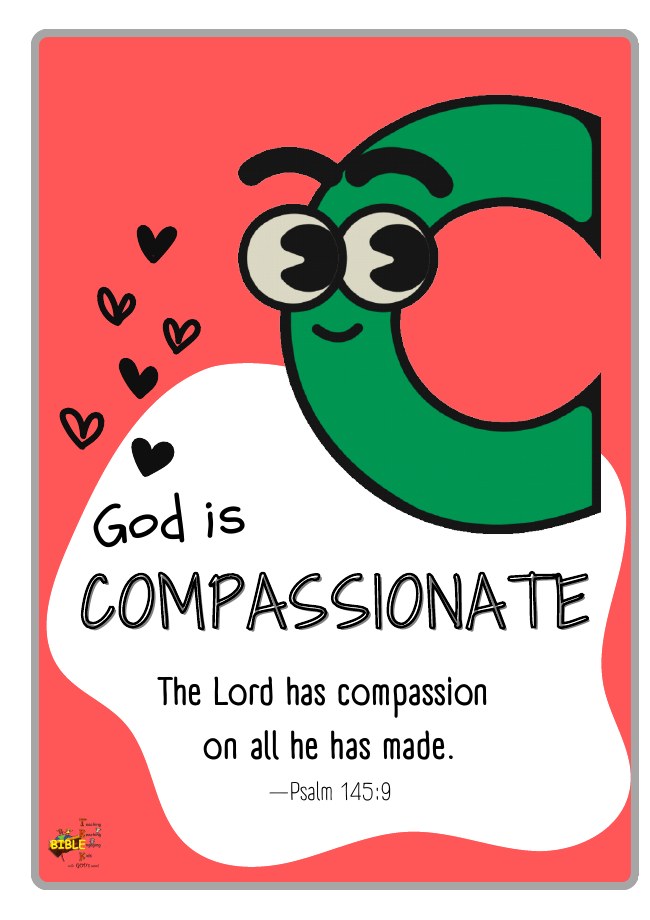
C — God is COMPASSIONATE
 Scripture: Luke 5:12–13 • Psalm 145:9 • Psalm 103:13
 Duration: 45–60 Min
 Intermediate and Primary

Trailhead Compass: Lesson Goal & Memory Verses
- Define compassion as Love in Action — seeing, feeling, and helping.
- Show how Jesus reached out and healed the outcast leper with compassion.
 Memory Verses
1. Worship Time
Begin with worship, actions, and singing aloud to Jesus. Help children follow actions, pick a beat, clap their hands, or just follow along.
2. Introduction: Prop Talk – A Stick
Material Needed:
- A long stick or a chart paper rolled to look like a stick
Introduction: Hi, kids! Look at what I’ve brought here today. (Hold up the stick.) It’s just a simple stick, right? (If you’re using a chart paper, ask the kids to imagine that it’s a stick) But let’s see what this stick can teach us about God. The Scepter of the King: Now, if I hold this stick like this (hold it upright like a scepter and pretend to be a King), who do you think I am? A king, right? Kings use scepters like this to show they are in charge, they have power, and they make important decisions. (Pause for kids to guess and respond.) Yes, just like a king, God is mighty and powerful. He is the King of everything, ruling with love and wisdom, as we learnt in the past few weeks. The Staff of the Shepherd: But now, look at what else this stick can be. (Hold the stick like a shepherd’s staff and pretend to be a shepherd) Who do you think I am now? Hint: Think of someone who takes care of sheep.” (Pause for kids to guess and respond.) That’s right, I’m like a shepherd! Shepherds use staffs like this to guide their sheep, keep them safe, and show them the right way to go. God – Almighty yet Compassionate: So, what does this tell us about God? It tells us that He is like a mighty king and a compassionate shepherd all in one. He has the power to rule everything, but He is also compassionate and cares for each one of us like a shepherd cares for their sheep. Compassion: Compassion means love in action. It’s not just about feeling sorry for someone; it’s about helping, caring, and making things better. Our God, though Almighty, is not distant or uncaring. He is a loving, compassionate Father. He’s close to us. He sees us, feels for us, and helps us. He’s the best king and the kindest shepherd we could ever have! Transition to the lesson:
Now, let’s take a closer look at how God’s mighty power is matched by His compassion. In Jesus, we see a beautiful example of compassion in action. He
showed love and kindness to everyone, including those who were sick or hurting. One such story is about Jesus feeling compassion for a man who was an outcast.
3. Story Time – A touch of God’s Compassion
One day, when Jesus was preaching, a man with leprosy came to Him. Do you know what leprosy is? Leprosy is a disease that affects the skin, nerves, limbs, and eyes. It can cause fingers and toes to become short and deformed. It’s an infectious disease, which means it can spread from one person to another. If you get too close to a leper, you could get infected with leprosy yourself. So nobody liked to be near a leper. If people saw a leper coming, they would go far, far away. These lepers were outcasts; they had to stay outside of town. When they came into town, they had to announce loudly, “Unclean, unclean,” to warn others of their presence. Can you imagine what it’s like to live like that? This leper must have been so tired of living this way. When he saw Jesus, he forgot all the rules of staying away from other people. He fell face down to the ground and begged Jesus, “Lord, if you are willing, you can make me clean.” This man must have heard of Jesus’ miracles. He knew Jesus could heal him. But was Jesus willing? Maybe he wasn’t good enough to be healed. Maybe Jesus couldn’t be bothered about someone like him. Maybe Jesus didn’t want to be contaminated by him. How do you think Jesus reacted? Jesus was moved by compassion. That means Jesus saw the man’s need, felt his pain, and decided to help. He reached out His Hand and touched the man. Isn’t that amazing? Nobody wanted to be near lepers. Nobody touched him for years. And here was Jesus, touching him! Jesus could have just stood at a distance and healed the man, but He reached out and touched him, showing His love. Then Jesus said, “I am willing. Be clean!” And immediately … the leprosy left him! Praise the Lord! Main Takeaway:
Compassion means love in action. This story demonstrates that God is compassionate. Jesus saw the leper’s need, felt his pain, and healed him. Our God, though Almighty, is not distant or uncaring. He is a loving, compassionate Father. Remember, God is always willing to reach out and touch us with His love and compassion.

4. Memory Verse Time
“The Lord has compassion on all he has made.” —Psalm 145:9
Simple hand motions to aid memorization:
“The Lord” – Point upwards with both hands, as if indicating someone above or higher, to represent God’s position as the divine authority. “has compassion on all he has made” – Bring both hands to your heart, as if holding something precious, and then extend your hands outward with an open, embracing gesture to represent compassion for all creation.
5. Game: Sponge Power!
Materials Needed:
- Hard stone
- Soft sponge or cotton ball
- Small amount of water
Instructions:

1. Introduction: Let me show you something interesting about compassion
using a stone and a sponge.
2. Show the Objects: Hold up the hard stone. “This stone is hard.” Hold up the
sponge or cotton ball. “This sponge is soft.” Allow the kids to feel the objects.
3. Pour the Water: Pour only a small amount of water on the floor. “Oh no! I’ve
messed up. There’s water everywhere. Let’s see which heart helps.”
4. Test the Stone: Place the stone in the water. “Let’s see if the stone helps.”
(The stone will remain unmoved in the water.) “The stone just lies there. It doesn’t help at all.”
5. Test the Sponge: Place the sponge in the water. “Now, let’s see what the
sponge does.” (The sponge will absorb the water.) “Look! The sponge absorbs the water. Now, touch the sponge.” (The kids will feel that the sponge is wet.) “The sponge saw the mess, the sponge felt the water, and the sponge helped by cleaning it up.”
6. Relate to Compassion: “The sponge is like a soft, compassionate heart. It
sees, feels, and helps. The stone is like a hard heart with no compassion. It doesn’t do anything to help. God’s heart is like the sponge. He sees us, feels for us, and helps us. He shows us compassion every day. Just like the
sponge, we should share God’s compassion with others. When we see someone in need, we should help them, just like God helps us.”
6. Craftivity: Activity Sheet
Materials Needed:
- A printout of “S5L3 – Activity Sheet – Beginners.pdf” for each child
- Cotton for sticking on the heart
Instructions: Give each child a copy of the activity sheet and guide them according to the instructions on the sheet.
7. Prayer Time
8. Summary
Main Takeaway:
- Compassion is LOVE IN ACTION.
- God is COMPASSIONATE – He sees. He feels. He helps.
- We should share God’s Compassion with others.
S5L3 – Activity Sheet – Beginners.pdf
Beginners – Activity Sheet God from A – Z Lesson 3 – God is COMPASSIONATE “The Lord has compassion on all he has made.” —Psalm 145:9 to re e nh to e a te t co at na ick cre assio . t S t mp a r co he
1. Worship Time
Begin with worship, actions, and singing aloud to Jesus. Help children follow actions, pick a beat, clap their hands, or just follow along.
2. Introduction: Prop Talk – A Stick
Material Needed:
- A long stick or a chart paper rolled to look like a stick
Introduction: Hi, kids! Look at what I’ve brought here today. (Hold up the stick.) It’s just a simple stick, right? (If you’re using a chart paper, ask the kids to imagine that it’s a stick) But let’s see what this stick can teach us about God. The Scepter of the King: Now, if I hold this stick like this (hold it upright like a scepter and pretend to be a King), who do you think I am? A king, right? Kings use scepters like this to show they are in charge, they have power, and they make important decisions. (Pause for kids to guess and respond.) Yes, just like a king, God is mighty and powerful. He is the King of everything, ruling with love and wisdom, as we learnt in the past few weeks. The Staff of the Shepherd: But now, look at what else this stick can be. (Hold the stick like a shepherd’s staff and pretend to be a shepherd) Who do you think I am now? Hint: Think of someone who takes care of sheep.” (Pause for kids to guess and respond.) That’s right, I’m like a shepherd! Shepherds use staffs like this to guide their sheep, keep them safe, and show them the right way to go. God – Almighty yet Compassionate: So, what does this tell us about God? It tells us that He is like a mighty king and a compassionate shepherd all in one. He has the power to rule everything, but He is also compassionate and cares for each one of us like a shepherd cares for their sheep. Compassion: Compassion means love in action. It’s not just about feeling sorry for someone; it’s about helping, caring, and making things better. Our God, though Almighty, is not distant or uncaring. He is a loving, compassionate Father. He’s close to us. He sees us, feels for us, and helps us. He’s the best king and the kindest shepherd we could ever have! Transition to the lesson:
Now, let’s take a closer look at how God’s mighty power is matched by His compassion. In Jesus, we see a beautiful example of compassion in action. He
showed love and kindness to everyone, including those who were sick or hurting. One such story is about Jesus feeling compassion for a man who was an outcast.
3. Story Time – A touch of God’s Compassion
One day, when Jesus was preaching, a man with leprosy came to Him. Do you know what leprosy is? Leprosy is a disease that affects the skin, nerves, limbs, and eyes. It can cause fingers and toes to become short and deformed. It’s an infectious disease, which means it can spread from one person to another. If you get too close to a leper, you could get infected with leprosy yourself. So nobody liked to be near a leper. If people saw a leper coming, they would go far, far away. These lepers were outcasts; they had to stay outside of town. When they came into town, they had to announce loudly, “Unclean, unclean,” to warn others of their presence. Can you imagine what it’s like to live like that? This leper must have been so tired of living this way. When he saw Jesus, he forgot all the rules of staying away from other people. He fell face down to the ground and begged Jesus, “Lord, if you are willing, you can make me clean.” This man must have heard of Jesus’ miracles. He knew Jesus could heal him. But was Jesus willing? Maybe he wasn’t good enough to be healed. Maybe Jesus couldn’t be bothered about someone like him. Maybe Jesus didn’t want to be contaminated by him. How do you think Jesus reacted? Jesus was moved by compassion. That means Jesus saw the man’s need, felt his pain, and decided to help. He reached out His Hand and touched the man. Isn’t that amazing? Nobody wanted to be near lepers. Nobody touched him for years. And here was Jesus, touching him! Jesus could have just stood at a distance and healed the man, but He reached out and touched him, showing His love. Then Jesus said, “I am willing. Be clean!” And immediately … the leprosy left him! Praise the Lord! Main Takeaway:
Compassion means love in action. This story demonstrates that God is compassionate. Jesus saw the leper’s need, felt his pain, and healed him. Our God, though Almighty, is not distant or uncaring. He is a loving, compassionate Father. Remember, God is always willing to reach out and touch us with His love and compassion.
4. Memory Verse Time
“As a father has compassion on his children, so the Lord has compassion on those who fear Him.” —Psalm 103:13
5. Fun with Science: Compassion Lift
Materials Needed:
- A carrot slice
- A glass of water
- Salt
- A spoon to add salt and stir the water
Instructions:
1. Introduction: “Compassion is not something we possess until we
demonstrate it to others.”
2. Demonstrating Compassion: “Imagine this carrot as someone who needs
help. Let’s see what happens when we drop the carrot into this glass of water. (Demonstrate by dropping the carrot into the water.) It sinks, right?”
3. Feeling Sorry vs. Acting with Compassion: “Now, let’s say we just feel sorry
for the carrot. We can’t bring it back up by just feeling sorry, can we? We need to do something. Compassion is like that; it’s not just about feeling sorry, it’s about taking action to help. Compassion sees, feels and helps.”
4. Adding Salt – Love in Action: “Now, let’s see what happens when we add salt
to the water. (Have the kids take turns adding spoonsful of salt to the bowl of water while stirring.) Look! The carrot starts to come up slowly. That’s like how when we show compassion to others, we help bring them up and make their lives better.”
5. Cross Connection: “God showed us ultimate compassion by coming down as
Jesus to save us. His love and compassion lift us up and give us new life. He wants us to show compassion to others too, just like He showed us compassion. Before sending out His disciples to minister, Jesus looked at the crowds and ‘felt compassion for them, because they were weary and worn out, like sheep without a shepherd’ (Matt. 9:36).”
6. Conclude by discussing specific ways the kids can extend God’s compassion
to others in their daily lives. (Here’s a video link of the experiment for better understanding https://youtu.be/2Ug3VkGbiVo?si=Of2SbIWV06ofiBb8 )
6. Craftivity:
Intermediate: Compassionate Heart
Materials Needed:
- A sheet of paper for each child
- Scissors, colors and twine(optional)
Instructions: Give each child a sheet of paper and ask them to draw and cut out a heart. On one side of the heart, have them draw or write one way God has shown compassion to them. On the other side, ask them to draw or write one way they can or have shown compassion to someone else. Once they have finished, invite the children to share and discuss their hearts with the class. After the discussion, you may string the hearts together on a twine to form a chain and display it in the classroom if possible. Primary: Compassion Quest with Psalm 103
Materials Needed:
- A bible and a sheet of paper for each team
Instructions:
1. Divide into Groups: Split the kids into three groups. Assign each group one
section of Psalm 103 – Group 1: Verses 1–6; Group 2: Verses 7–12; Group 3: Verses 13–19
2. Reading and Discussion: Have each group read their assigned verses. Ask
them to list what God has done to show His love. Use the following reference to guide their discussion: (Verses 1–6) He forgives our sins. He heals diseases. He redeems our lives. He crowns us with love and compassion. He satisfies our desires with good things. He is righteous. He gives justice to the oppressed. (Verses 7–12) He leads people throughout history. He shows compassion and grace. He is slow to anger. He is love. He does not treat us as our sins deserve. (Verses 13–19) He has compassion on His children. He made us. He is eternal. His love is with those who fear Him. His kingdom rules over all.
3. Explanation and conclusion: Bring the groups together, combine the lists and
briefly explain each deed, highlighting God’s love and compassion. Also, encourage the kids to share how God has shown compassion in their lives.
7. Prayer Time
8. Summary
Main Takeaway:
- Compassion is LOVE IN ACTION.
- God is COMPASSIONATE – He sees. He feels. He helps.
- We should share God’s Compassion with others.
Slide-by-Slide Walkthrough (8 Slides)
Cover, Story Slide & Printable Previews (3 Images)

Leave A Comment